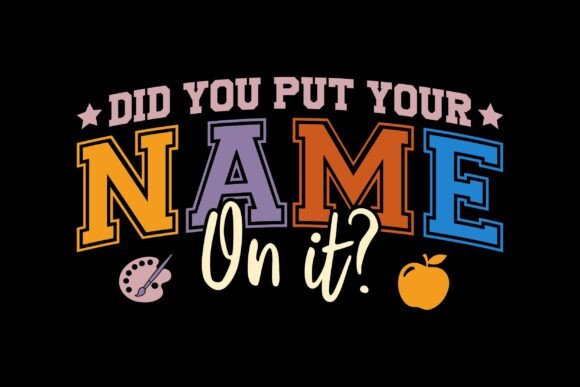
Did You Put Your Name on It: A Designer Review
As a designer who has spent years navigating the intersection of digital art and physical thread, I approach every new asset with a critical eye. The market is flooded with T-Shirt Designs that look crisp on a screen but fall apart under the tension of an embroidery hoop. When I first encountered the design titled Did You Put Your Name on It, my immediate reaction was one of cautious optimism. It promises a playful, personalized touch, which is exactly what many small shop owners and Etsy sellers are hunting for. However, the real test lies in how this graphic translates from a flat image to a textured, three-dimensional finished product.
The concept itself is clever. In a world where branding is often about logos and slogans, asking "Did You Put Your Name on It?" flips the script. It invites personalization, making it an ideal candidate for custom apparel or a unique personalized gift. Visually, the layout appears balanced, designed to sit comfortably on a chest pocket or centered on a tote bag. But does it hold up when you consider the mechanics of stitching? Let's dive into the practical realities of using this design in a real-world embroidery project.
Visual Impact and Design Personality
At first glance, Did You Put Your Name on It exudes a friendly, slightly cheeky vibe. The typography is bold enough to command attention without feeling aggressive. For a craft business looking to add character to their inventory, this kind of visual personality is gold. Unlike complex illustrations that require hundreds of thousands of stitches, this design relies on clean lines and clear shapes. This suggests it will likely perform well as a standard machine embroidery design, avoiding the common pitfalls of over-stitching that can pucker delicate fabrics.
However, the true value of this graphic lies in its adaptability. Whether you are creating a sweatshirt embroidery piece for a cozy winter collection or a bright tote bag design for summer craft fairs, the text-based nature of the artwork allows for significant flexibility. You aren't locked into a single color palette. This means you can swap out thread colors to match seasonal trends or specific brand identities, ensuring your small shop product stays fresh throughout the year.
Real-World Application: The Personalized Tote Scenario
To truly understand the utility of Did You Put Your Name on It, imagine a specific scenario. You run a boutique that specializes in eco-friendly accessories. A customer walks in wanting a custom canvas tote bag for her daughter's upcoming birthday party. She wants something fun but professional. This is where the design shines. The phrase naturally accommodates a name insertion, turning a generic item into a cherished keepsake.
In this context, the design functions perfectly as a baby embroidery option or a youth-centric item. The text is legible even from a distance, which is crucial for items like bags that move around. If you were to use this on a pillow cover or a kitchen towel, the durability of the stitch pattern becomes paramount. Since the design appears to rely heavily on lettering, the success of the project hinges on the quality of the fill stitch within the letters. Poorly digitized fonts can lead to gaps in the stitching, causing threads to snag or fray after washing. Before committing to a batch production, I would strongly advise testing this on a scrap piece of the actual fabric you intend to use.
Navigating Fabric and Hoop Challenges
While the design looks promising, there are specific situations where caution is required. Embroidery is not just about the image; it is about the interaction between the needle, the thread, and the material. If you plan to use Did You Put Your Name on It on textured fabrics like denim or heavy fleece, you must ensure the stitch density is high enough to anchor the design without distorting the weave. Conversely, on thin or stretchy fabrics like jersey knit, the weight of the thread could cause puckering if the stabilizer isn't chosen correctly.
Another critical consideration is the hoop size. While the design seems compact, always verify the dimensions against your machine's capabilities. Attempting to fit a design that is too large into a small hoop can result in shifting, leading to misaligned text—a disaster for any commercial embroidery project. Additionally, if you are considering this for caps or curved surfaces, the flat nature of the text might need adjustment to wrap properly around the curve. A design that looks straight on a t-shirt might appear distorted on a hat brim unless re-digitized specifically for that application.
Practical Notes for the Professional Maker
If you are an Etsy seller or a creative entrepreneur planning to sell items featuring this graphic, here are my essential recommendations:
- Test First: Never skip the test run. Stitch out Did You Put Your Name on It on a sample swatch of your intended fabric. Check for thread breaks, tension issues, and overall clarity.
- Check Contrast: Ensure the thread colors you select offer sufficient contrast against the background fabric. Light grey thread on a white shirt will disappear once stitched.
- Review Licensing: Before listing items for sale, confirm the licensing terms provided by the Professional T-Shirt Design Store. Ensure you have the right to use the design for commercial embroidery and selling finished goods.
- Mockups Matter: Create printable mockups in both black and white and full color to see how the design reads in different contexts. This helps potential buyers visualize the final product.
- Stabilizer Selection: Use a tear-away stabilizer for stable fabrics and a cut-away for stretchy materials to maintain the integrity of the Graphics over time.
Value and Customer Perception
Ultimately, the decision to use Did You Put Your Name on It comes down to the value it adds to your brand. In the crowded marketplace of handmade goods, designs that encourage personal connection stand out. This particular graphic does exactly that. It sparks conversation and creates a sense of ownership for the recipient. When a customer sees their name stitched neatly onto a high-quality item, their perception of value skyrockets.
For the digital product seller offering this as a downloadable embroidery file, the appeal is equally strong. Makers love assets that are versatile and ready to use. By providing a design that works across various applications—from holiday embroidery gifts to everyday wearables—you are offering a tool that generates revenue for them. However, the responsibility falls on the user to execute it well. A poorly stitched version of a great design can damage a maker's reputation just as quickly as a bad product can.
In conclusion, Did You Put Your Name on It is a solid addition to any design assets library. It strikes a balance between playfulness and professionalism, making it suitable for a wide range of projects. Whether you are decorating a wedding gift, creating nursery decor, or stocking your boutique shelves, this design offers a reliable foundation. Just remember to respect the technical requirements of embroidery: choose your stabilizer wisely, test your settings, and always prioritize quality over speed. With careful execution, this design can become a best-seller in your own shop.